The end of World War II marked the beginning of an unspoken era in our history: the baby scoop era. Conservatives, obsessed with an idyllic 1950s America that never really … Continue reading The Second Wave Baby Scoop
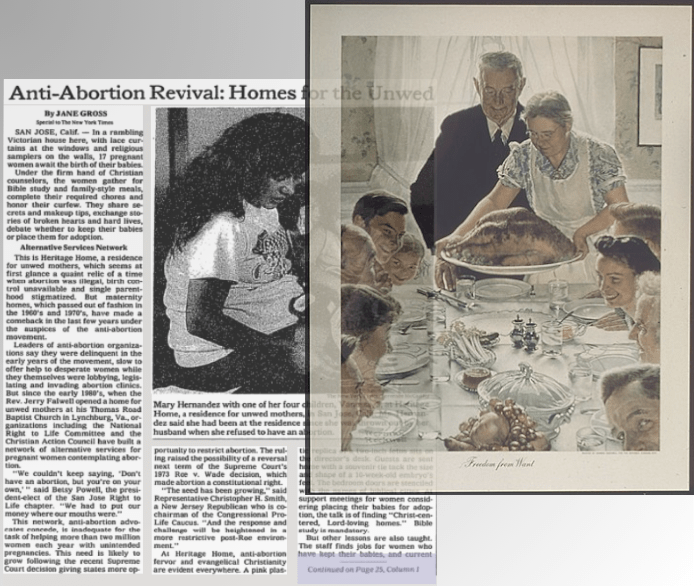
The end of World War II marked the beginning of an unspoken era in our history: the baby scoop era. Conservatives, obsessed with an idyllic 1950s America that never really … Continue reading The Second Wave Baby Scoop
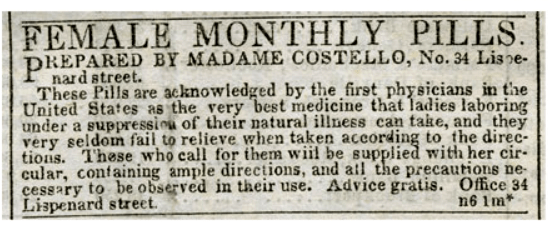
The anti-abortion movement would have you think that they are coming from a “reasonable” place to “protect life.” This narrative is downright false, unless you ignore the brutal history of restricting access to bodily autonomy and the criminalization of abortion dating back to colonial times. Let’s go down the rabbit hole together:
Abortion is a heavily stigmatized subject. For decades, right-wing forces and the church have been on a misinformation campaign on abortion. Part of the fight for abortion access and reproductive justice includes destigmatizing abortion and taking back our narrative.
It’s past time to name and demand what we need. We only destigmatize abortion by using the word abortion.
Sometimes choosing abortion is a difficult decision, and sometimes it’s not – there are many nuances around having an abortion. All abortions and decisions to have an abortion are unique, individual, and deserve respect.
Telling your story (if it’s safe for you to do so) helps give a face to the statistics. This is a crucial aspect of destigmatizing abortion by showing that it is far more common than people seem to think. Nearly 1 in 4 people will have an abortion by the age of 45.
“I would never have an abortion” is a very common thought that many people have — until they need to get an abortion. The fact of the matter is, abortion is a life saving healthcare procedure that millions of people obtain a year. For many people, one of the hardest parts is the stigma surrounding abortion.
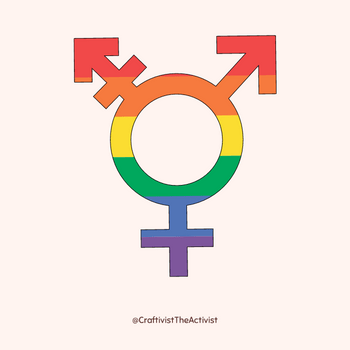
(Cis) women are not the only people who obtain abortions. When the conversation around abortion and/or reproductive healthcare only includes cis women, it excludes trans men, intersex people, nonbinary people, and other gender-nonconforming folks from the conversation. Leaving them out of the conversation dismisses their reality and removes any concept of solidarity that needs to be built and maintained for a liberating mass-movement. When applicable, it’s best to use the gender neutral language i.e. “pregnant people”, “people with uteruses”, & other similar phrases to be inclusive to our transgender, nonbinary, intersex, and other gender nonconforming comrades.
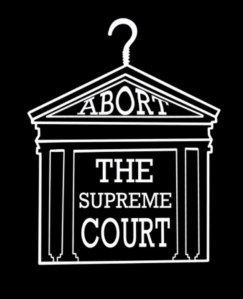
Coat hanger images and “back-alley” references are problematic; they lead people to think that all self-managed abortions are dangerous, when in fact self-managed abortions are the safest they’ve ever been thanks to the availability of abortion pills (which the FDA recently approved to be delivered by mail.) The stigmatization and coat hanger/back-alley narrative of the past fuel justification for outlawing self-managed abortions.
Want to print off a copy to share with friends or family? Below are free PDF’s, donations are accepted.
Since the passing of Roe v Wade (1973) and Planned Parenthood v Casey (1992), it has been heavily under attack by republican congress members. From January 1, 2021 to April 15, 2022, over 536 abortion restrictions have been introduced in 42 states; so far, 33 of those restrictions have been enacted in 9 states. When Roe is overturned, 13 states will immediately ban abortions & 13 more are likely to make it nearly impossible to get an abortion; thus leaving many in the South & the Midwest without access to reproductive healthcare for hundreds or even thousands of miles in some instances.
On Monday May 2, 2022, the SCOTUS draft majority opinion was leaked in regards to Dobbs v. Jackson’s Women’s Health Organization — a case that could (& most likely will) overturn Roe v. Wade & Casey v. Planned Parenthood. Our current SCOTUS is majoritively, 6 out of 9, both conservative & Christian, meaning that our rights to bodily autonomy, privacy, & receiving healthcare will likely be taken away in the coming months.

On September 1, 2021, Texas’ six week abortion ban went into effect. This outlaws any abortions once a fetal “heartbeat” is detected and does not allow for exceptions, even in cases of rape or incest. Rather than the state prosecuting abortion seekers and/or providers, S.B.8 allows for private citizens to sue abortion seekers and/or providers for $10,000 per abortion.
Fetal heartbeat abortion bans are a basic human rights violation and a crime against humanity according to the UN. Most people, unless they are actively trying to conceive, don’t realize they’re pregnant until week 7, meanwhile fetal “heartbeats” can be detected as early as 6 weeks. The term “fetal heartbeat” – especially before 6 gestational weeks – is misleading in the sense that it’s merely electrical cells (that would later form to become the heart), and what’s actually heard is actually the sonography machine at that point.
S.B. 8. has subsequently brought about detrimental effects to people who’ve became pregnant. This law has since caused physical, psychological and mental distress, trapping people into a cycle of poverty, forcing children as young as 11 carry a fetus to term, compelling chronically disabled people to carry a fetus to term, making people have to drive hundreds of miles to receive medical care, forcing people to preform back-alley abortions, overall strong-arming these people into carrying their pregnancy to term, whether or not they capable of bringing it to term.
Planned Parenthood released a briefing of 33 interviewees (view entire brief here) only 1 month and 10 days after the bill was enacted into law by Texas representatives and Governor Greg Abbott. The brief outlines the grave, horrific realities many pregnant people, even children, have gone through and will continue to have to go through unless this law gets repealed. Some women were petrified when they found out about their pregnancy because they weren’t sure how they were going to get out-of-sate for their abortion due to various factors like being on probation, undocumented, sexually assaulted, etc.
*All initials are pseudonyms to protect interviewees’ privacy.
-T.K. suffers from a chronic disease for which she has been unable to get
medication for eight months. She fears the stress of the pregnancy “would
probably kill [her].”
T.K. said she is not financially stable enough to raise a child. Having grown
up in poverty, she “[doesn’t] want that cycle to happen again.” She noted that
baby formula costs $18 per canister but she barely earns over $20,000 a year.
As a child, T.K. was sexually abused in the care of extended family. She
would not trust anyone to care for her child given the abuse she suffered. She was
relieved to secure an out-of-State abortion, but was worried that because of SB8,
“they’d be waiting to drag [her] off to jail when [she] got here because [she’s] from
Texas.
-Nurse practitioner T.W. saw a young teen who came from Texas to
Oklahoma after being raped and impregnated by her father. Unfortunately, the
family member taking care of her lacked the guardianship forms to be able to
consent to the abortion, and they had to turn her away.
-J.T. is in her mid-thirties with seven children, and recently lost employment
when they contracted COVID-19. She explained that she “can’t have another
child” and that her “seven children come first.”
J.T. was too far along to have an abortion in Texas and considered buying
“pills” online. With Mississippi appointments booking nine weeks out, J.T. woke
up at 4 a.m. to drive six hours to Oklahoma. She split up her children among
various caretakers. She said that hotel, food, and gas “took away over half of what
I make in the month…”
-I.O., in Houston, spoke of a twelve-year-old patient who came in with her
mother, a single working mother with other children. The mother said they could
not travel out-of-State—they had barely made it to the Texas health center. The
twelve-year-old said, “Mom, it was an accident. Why are they making me keep
it?”
Laws like Texas’ six week abortion ban are a dangerous and slippery slope that will lead to unnecessary traumatic and lethal consequences. Abortion bans prevent people from getting the necessary [and sometimes even life-saving] medical care they need. When a bounty is added on top of a ban, this traps people in a cycle of poverty, force them into parenthood no matter the readiness and/or desire to become a parent, and can enable domestic abusers (by holding either the abortion or the child, once its born, over the domestic victims head).
Laws like this must be fought against. In an effort to help save reproductive rights, right to privacy, and right to bodily autonomy: donate to your local Planned Parenthood (or any other reproductive health/abortion center), find a local organization that advocates for abortion rights, and urge your congress-member to pass the “Women’s Health Protection Act” and to repeal any legislation that prohibits abortion access.
 Craftivist The Activist
You must be logged in to post a comment.