
History of anti-abortion centers
So-called “crisis pregnancy” centers have a long history and deep ties to the anti-abortion movement and the broader conservative movement. Click a year to learn more.
1967
Colorado is the first state to legalize abortion.
In direct response, an anti-abortion activist in Hawaii named Robert Pearson founded the nation’s first “crisis pregnancy center” the same year.

Photo of Robert Pearson. Pearson stated in a later speech,
“Obviously, we’re fighting Satan. A killer, who in this case is the girl who wants to kill her baby, has no right to information that will help her kill her baby. Therefore, when she calls and says, ‘Do you do abortions?’ we do not tell her, No, we don’t do abortions.”
https://www.motherjones.com/files/cpchistory2.pdfNixon Administration (1969-1974)
President Nixon established Title X funding, which is a federal grant program dedicated to providing low-income families or uninsured people (including those who are not eligible for Medicaid) with comprehensive family planning and related preventive health services.
Since its inception, Title X has not directly provided funds for programs that use abortion as a family planning method. At the same time, by preventing unintended pregnancies, Title X has decreased the number of abortions in the US.
1969
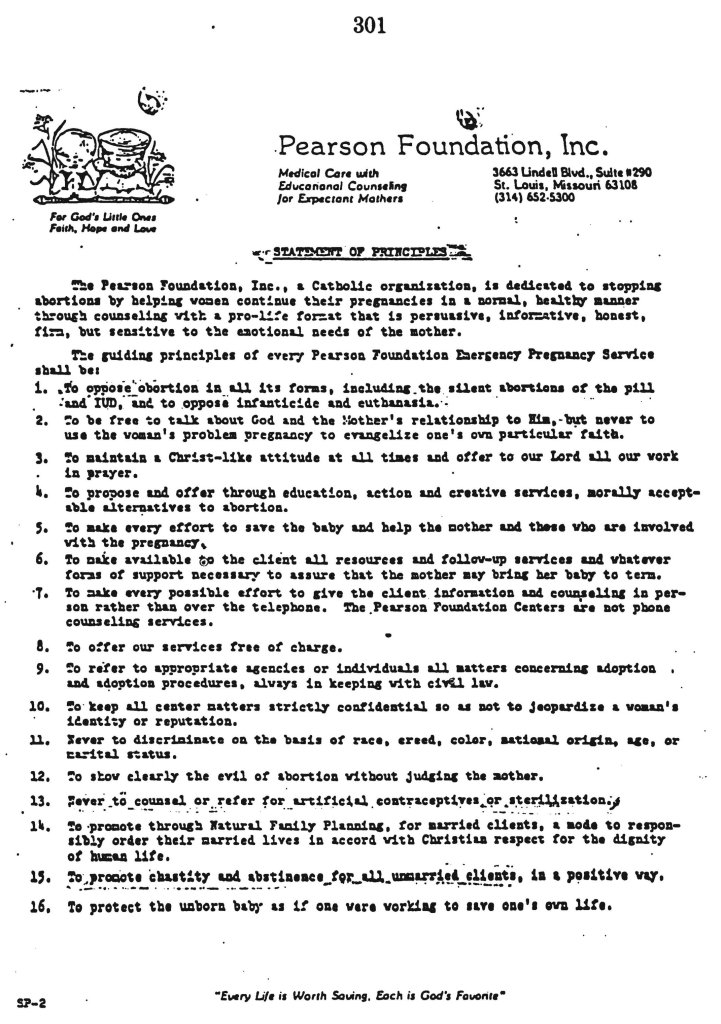
In an effort to promote the pregnancy center movement, Pearson established the Pearson Foundation, a St. Louis-based organization to assist local groups in setting up “crisis pregnancy centers”. The organization provides:
- Training sessions
- Slide shows – such as “Caring”: a 27-minute show that “includes many pictures of bloody fetuses in waste cans and one of a gurney carrying a woman who is apparently dead and is covered by a sheet. It ends by comparing abortion to the final solution”
- Pamphlets
- Discounted video equipment
- Kits to perform urine tests
- A manual entitled ‘How to Start and Operate Your Own Pro-Life Outreach Crisis Pregnancy Center (1984)’
1971
Heartbeat International, originally Alternatives to Abortion, was founded as hotlines and pregnancy help services.
1973
Roe v. Wade is ruled on by the Supreme Court.
When Roe passed, many Evangelicals were either happy or neutral as they viewed abortion as a Catholic issue. One poll in 1970 conducted by the Baptist Sunday School Board found that 70% of Southern Baptist pastors supported abortion to protect the mental or physical health of the mother, 64% supported abortion in cases of fetal deformity and 71% in cases of rape. Three years later, another poll conducted by the Baptist Standard news-journal found that 90% of Texas Baptists believed their state’s abortion laws were too restrictive.
The Southern Baptist Convention even passed resolutions in 1967, 1974, and 1976 to legalize abortion.
It is not until the late 1970s that [white] Evangelicals are mobilized as a voting block using abortion as a wedge issue and the southern strategy.
1975
CareNet, originally The Christian Action Council, was founded.
1976
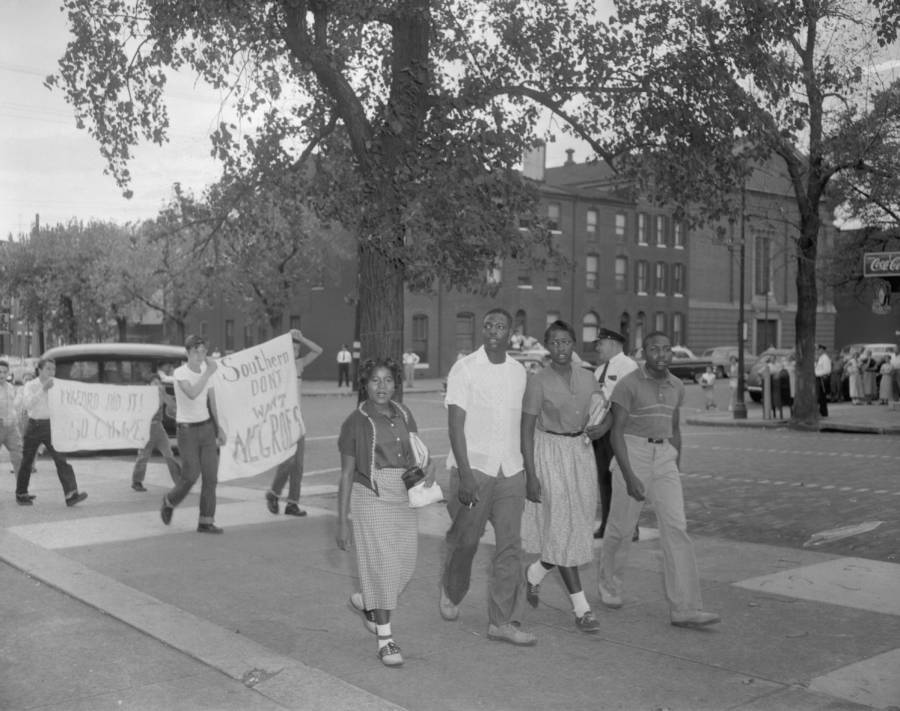
After more than two decades of opposition to the Brown v Board of Education ruling which declared the “separate, but equal” doctrine unconstitutional, the IRS revoked Bob Jones University’s tax-exempt status.
Image Summaries
- Bob Jones University.
- A mob of white teenagers protest school integration in Montgomery, Alabama, in 1963.
- Elizabeth Eckford from the Little Rock Nine being harassed by an angry white mob as she attempts to integrate Little Rock Central High School on September 4, 1954.
- Integrated bussing in Charlotte, NC.
- White students taunt Black students with a racist sign outside of a Baltimore high school.
This outraged Evangelical leaders like Jerry Falwell, Paul Weyrich, and Francis Schaeffer. Instead of mobilizing in defense of segregation, which they knew was a losing battle, they turned their focus towards abortion.
1979
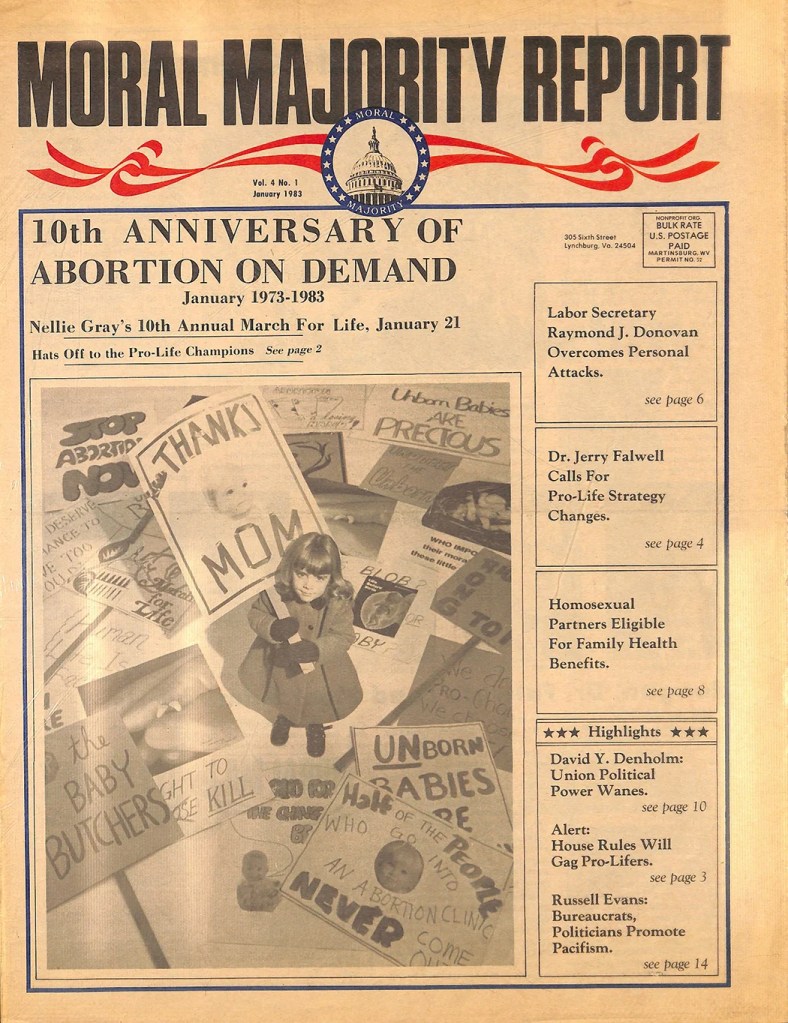
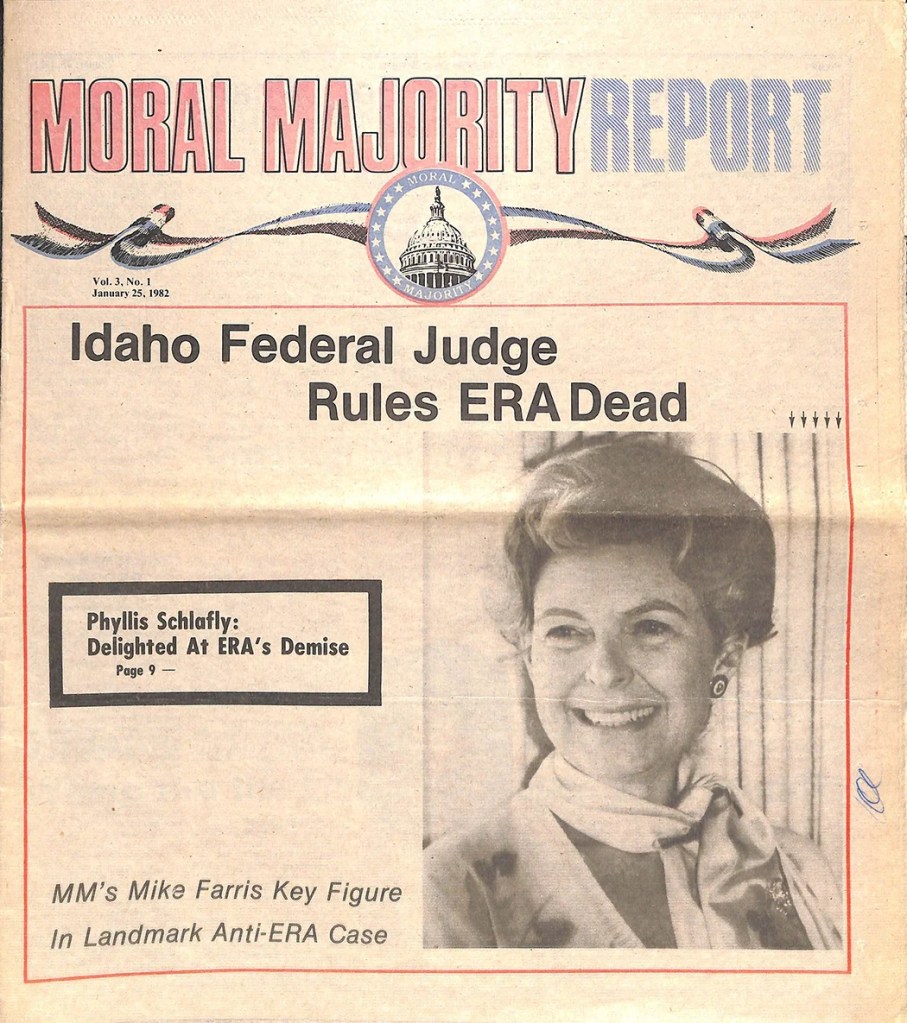
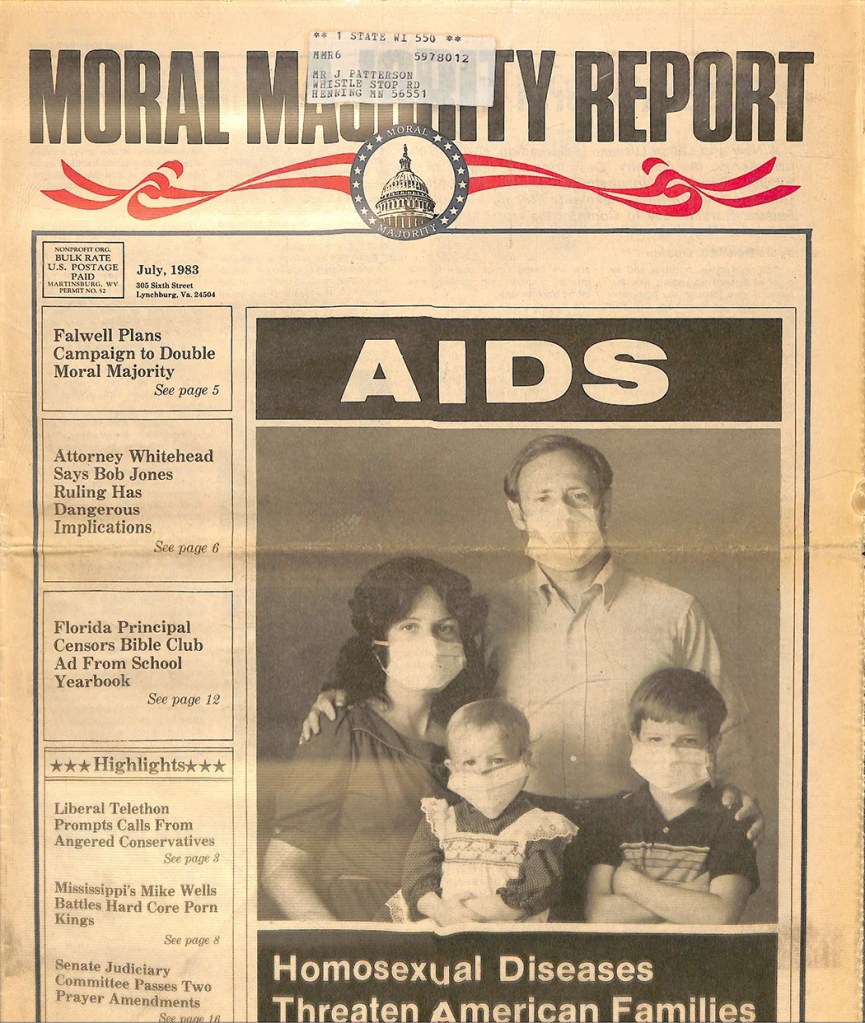
From the late 70’s and into the 80’s Evangelical leaders such as, Jerry Falwell, Francis Schaeffer, and Paul Weyrich, teamed up and founded the “Moral Majority” to promote conservative social causes (ie promoting the prohibition of abortion in all cases, banning pornography, traditional family values, anti-LGBTQ, anti-ERA, converting Jews and non-Christians to Christianity, prayer in public schools, etc).
They began giving sermons to mobilize the masses of white, conservative, Evangelical Christians (especially across the South, although their work extended well beyond the South) in America. Before this, this demographic wasn’t too politically engaged. In these sermons, they tapped into a sense of “moral decay” which resonated with many and used violent rhetoric in their sermons that emboldened anti-abortion extremists to justify the violence committed against abortion clinics and providers.
During the 1980s CareNet and Heartbeat International focused on growing their base, funding, models and methods.
Violence from anti-abortion protesters increased in tandem with the rise of religious anti-abortion organizations like the Moral Majority and Operation Rescue.
Reagan Administration (1981-1989)
While the Ford and Carter administrations did not get involved with anti-abortion centers, Reagan was a friend to the anti-abortion movement.
Before 1987 the Reagan administration tried to change the strategy of family planning from sex education, contraception and abortion to advocating abstinence, adoption counseling, infertility counseling, and natural contraception. This tactic failed because the Reagan administration was only able to divert $5 million towards these new goals. Congress was the administration’s primary obstacle. Another unsuccessful tactic was to change the method of funding by moving the money to block grants which all states received from the federal government to do with basically as they pleased (the Clinton Administration would eventually enact this change). But Congress went ahead and funded Title X directly in the usual manner. After 1986 the Reagan administration found a new avenue to accomplish its policy change. The “Superbill” as it is called would restrict funding to any clinics that refer for abortion, counsel for abortion or are closely overlapping fiscally or physically with abortion services. The administration also rail-roaded through new regulations to this effect in case Congress did not pass the Superbill. As of the writing of this article, pro-family planning organizations have gotten court injunctions to block the new regulations.
1984
Pearson publishes the manual entitled “How to start and operate your own pro-life outreach pregnancy center” which he outlines specific rhetorical strategies for diverting women who might be considering abortion to carry the pregnancy to term and consider alternate routes such as adoption or parenting while pushing conservative Christian values.
1986
Operation Rescue was founded. Their tactics consisted of sit-ins (which the founders claim was inspired by the civil rights movement) and clinic blockades. Individuals linked arms to block access to an abortion clinic while “sidewalk counselors” directed women to the nearby anti-abortion centers.
1991
A congressional investigation condemned anti-abortion centers for consumer fraud and misleading advertisement. This is one of the first investigations by the government into anti-abortion centers.
In response to the investigation and criticism, the national anti-abortion organizations, Heartbeat International and Care Net, began to standardize AACs’ training and materials, attempting to transform them into institutions that offer advice and support. Anti-abortion organizations also begin to create licensure programs for their physicians to run ultrasound equipment, hire part-time medical providers, and purchase ultrasound equipment.
Anti-abortion centers began to run abstinence-only sex education programs in public schools. This coincides with the rise of the “purity movement” in the 90’s.
1993
The National Institute of Family and Life Advocates (NIFLA) is founded (currently affiliated with about 1,600 centers). They provide legal counseling to anti-abortion centers. NIFLA spearheaded the use of ultrasound technology in their affiliate centers, which they use to deceive and emotionally manipulate pregnant people into carrying their pregnancies to full term. NIFLA undertook this approach in the mid-1990s, which led to the founding of their “Institute of Limited Obstetric Ultrasound” and later The Life Choice (TLC) Project, both of which equip and train AACs with ultrasound machines and other materials to carry out their deceptive and manipulative goals.
“Alternatives to Abortion” changes its name to Heartbeat International.
Clinton Administration (1993-2001)
The George H W Bush Administration didn’t fund anti-abortion centers, but they did continue Title X funding restrictions that were implemented during the Reagan era.
When welfare was administered through the Aid to Families With Dependent Children program, almost all of its funds were used to provide single-parent families with cash assistance. But when President Bill Clinton reformed welfare in 1996, replacing the old model with Temporary Assistance for Needy Families (TANF), he transformed the program into a block grant that gives states considerable leeway in deciding how to distribute the money — as Reagan originally wanted. As a result, states have come up with rather creative ways to spend TANF dollars; funding anti-abortion centers, abstinence programs, etc.
1994
After more than a decade of clinic blockades and violence against abortion clinics and providers, President Clinton signs the Freedom of Access to Clinic Entrances (F.A.C.E.) Act into law. The F.A.C.E. Act forbids the use of “force, threat of force or physical obstruction” to prevent someone from providing or receiving abortions. The FACE Act was brought on by “Operation Rescue” and anti-abortion violence resulting in the murders of two doctors.
1996
Due to Clinton’s Welfare Reform, Pennsylvania becomes the first state to divert federal Temporary Assistance for Needy Families (TANF) funding to anti-abortion centers. This funding is supposed to go to low-income families but state legislatures instead divert it to anti-abortion centers.
Today, at least 13 states divert TANF funding to anti-abortion centers – including North Carolina.

President Clinton’s welfare-reform act allocated fifty million dollars a year to abstinence-training programs (this is another ploy for AACs to gain government funding).
Choose Life license plates are founded in Florida.
Bush Administration (2001-2009)
During the first term of the Bush Administration (2001-2005) over $30 million in federal funds were provided to more than 50 anti-abortion centers across the country.
In 2006, an investigation by the US House of Representatives Committee on Government Reform found that the majority of anti-abortion centers that were given funding during the Bush Administration provide false and misleading information about abortion.
2002
CareNet launches OptionLine in a joint venture with Heartbeat International.
Obama Administration (2009-2017)
Despite being a supporter of abortion access and funding for contraception, the Obama Administration continued funding for anti-abortion centers through the “fatherhood initiative” program, a program many anti-abortion centers have to promote “traditional family values”.
Starting in the 2010s, anti-abortion centers & their affiliate organizations begin challenging attempted regulations in court.
2011
Choose Life license plates are brought to North Carolina through the enactment of H.B. 289.
2012
CareNet launched the Pregnancy Decision Line.
“Choose Life” license plates in NC were ruled unconstitutional. A district court judge ruled that the state’s attempt to offer ONLY the anti-abortion plates represents “viewpoint discrimination in violation of the First Amendment”.
2014
The Supreme Court ruled on McCullen v Coakley.
For context: In 2000, Massachusetts passed the Reproductive Health Care Facilities Act, which was broadly modeled off laws upheld by the Supreme Court in Hill v. Colorado. The Act was an 18-foot buffer zone around reproductive healthcare facilities that prohibited approaching within six feet of another person “for the purpose of passing a leaflet or handbill to, displaying a sign to, or engaging in oral protest, education, or “counseling” with such other person”, unless this was done with the person’s consent. The Act also contained a prohibition against obstructing a person who was entering or leaving such a facility. The Act was amended in 2007 to replace the 18-foot radius with a 35-foot radius around reproductive healthcare facilities.
An anti-abortion protester challenged the law resulting in a 9-0 Supreme Court ruling where the Massachusetts law was struck down stating that the 35-foot radius was unconstitutional.
2016
In a 2-1 ruling, the U.S. Court of Appeals for the Fourth Circuit reversed its earlier ruling that a 2011 North Carolina law allowing specialty license plates that say “Choose Life,” but not an alternative plate with a message supporting reproductive freedom, was unconstitutional. In the ruling, the court now says North Carolina is under no obligation to offer a pro-choice plate, and it sent the case back to the district court to enter judgment for the state.
Trump Administration (2017-2021)
In 2019, HHS issued new regulations revising the interpretation of Section 1008 of the Title X statute that states, “none of the funds appropriated under this title shall be used in programs where abortion is a method of family planning.” Historically, this has largely been interpreted to mean that no funds are used to pay for abortions and clinics have maintained a full financial separation of Title X from other funding that supports abortions. The Trump Administration had a broader interpretation of this section and issued new regulations that prohibit Title X clinics from providing abortion referrals, require physical separation of abortion services, and mandate prenatal care referrals for all pregnant women.
In other words, Title X providers could explicitly direct pregnant patients to only prenatal care — and would lose their funding if they mentioned abortion care, even if it was something the patient asked about themselves. The Trump rule was challenged in court, but the suit against it was ultimately dismissed by the Supreme Court.
2018
The Supreme Court ruled on the National National Institute of Family and Life Advocates v Bercarra.
For context; California passed the Reproductive FACT Act which mandated that “crisis pregnancy centers” provide certain disclosures about state services. The law required that licensed centers post visible notices that other options for pregnancy, including abortion, are available from state-sponsored clinics. It also mandated that unlicensed centers post notice of their unlicensed status.
The Supreme Court ruled in a 5–4 decision that California’s version of such a disclosure statute likely amounted to compelled speech impermissible under the First Amendment and that the notices required by the FACT Act likely violate the First Amendment by targeting speakers rather than speech.
On an adjacent note.. some states, especially states that are hostile towards abortion access, require abortion clinics to provide biased, medically-inaccurate counseling before providing an abortion (including North Carolina).
Biden Administration (2021-)
The Biden Administration campaigned on restoring Tite X funding and has followed through on it. That said, the new rule change doesn’t magically flip a switch for the providers that left the Title X network. Seven states withdrew from Title X altogether under Trump, and several other of the country’s largest states have swaths with no Title X providers. Any provider or clinic that left the program outright can’t come back in until the government runs a new competition for grant administration.
2022
After the Dobbs decision was announced that overturned Roe v Wade, Senate Democrats asked Heartbeat International to provide information about how the organization gathers, protects, and shares the personal data of pregnant people who seek out its services, spotlighting concerns that the data could be used in abortion-related prosecutions.
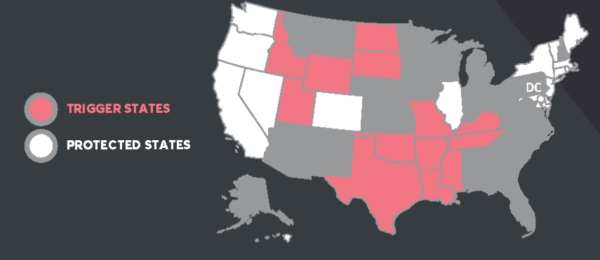
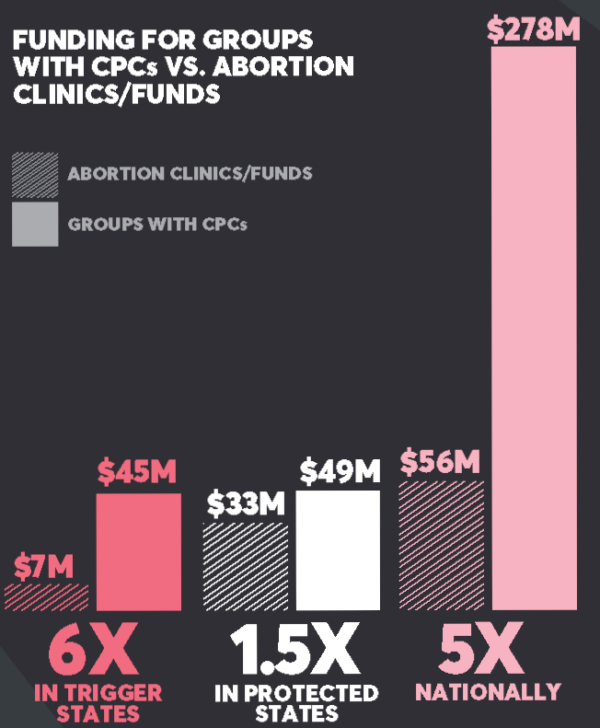
New research shows anti-abortion centers hold a 5:1 funding advantage over legitimate abortion clinics and funds. This disparity gets as high as 7:1 in trigger states. This massive resource imbalance created by disproportionate funding helped build the foundation that anti-abortion groups used to overturn Roe v Wade and continues to be essential to efforts to decimate abortion access across the country.
2023
In May, Illinois passed S.B.1909 which allows the state Office of the Attorney General to investigate complaints against anti-abortion centers using questionable tactics and strengthens the attorney general’s authority to prosecute incidences of consumer fraud in such cases. Shortly after, the Thomas Moore Society filed a lawsuit challenging the legislation.
By August, a Trump-appointed federal judge ruled in favor of the Thomas More Society calling the legislation “painfully and blatantly a violation of the First Amendment”.
It goes without saying that organizations that oppose abortion and hold conservative views strongly detest being subjected to regulations that prohibit them from employing misleading advertisements or spreading false information, while simultaneously advocating for their rights under the First Amendment.





Thanks for reading! A note from the author: In the wake of the Dobbs decision, the North Carolina Triangle Democratic Socialists of America Socialist Feminists decided to focus our efforts on anti-abortion centers as they work to intercept and deceive people who are seeking abortion care and target vulnerable communities while posing as a potential individual and/or public health risk. We believe that you should make whatever reproductive decision that’s best for you and be supported in it. Everyone deserves access to quality, patient-centered healthcare fueled by compassion not coercion — without access there is no choice. Again, thank you for reading through this.
Discover more from Craftivist The Activist
Subscribe to get the latest posts sent to your email.
 Craftivist The Activist
You must be logged in to post a comment.